Maybe you could help me with this

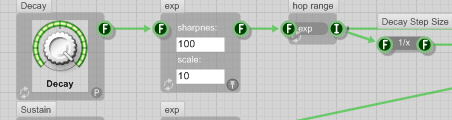
What does the first part do?
- 8a97fuiz2i2.PNG (17.28 KiB) Viewed 13165 times
I see a knob value with 0-1 comes trough. But what is sharpness and scale for?
The result of the "exp" box is bewteen 0-10 - the scale float multiplied the 0-1 result up to 0-10.
Actually I can simply delete the "exp" box and it still works. Is that exp-box only for making the knob exponential in it's behavior - like becoming more sensible in higher or lower knob ranges?
And the hop-box does what? Making it hop some samples to not be calculated?
The main variables needed before the code comes are: decaySamplesHoped, decayStepSize and curve( 1 to -1 )?
But I guess the code which calculates the decay is the most important. But it is written with the assembler - I don't understand that
Is the assembler more efficient in cpu usage than the code or why do you use it? If yes, how much
I need the most important part: the decay calculation. If on every sample the volume becomes calculated through a code block, I need a simple calculation which uses the current time already passed (which gets updated on every cycle within the variable currentSample). And there would be two other knobs to control the curve in it's shape/exponantial and tell the code how long the decay should last.
Let's say I have these current values:
currentSample = 200
decayTime = 44100 samples (would be one second)
curve = not sure what is needed here (maybe the exponent)
maxVolume would be 1 I guess
Can I calculate the currentVolume with only these values on every cycle?